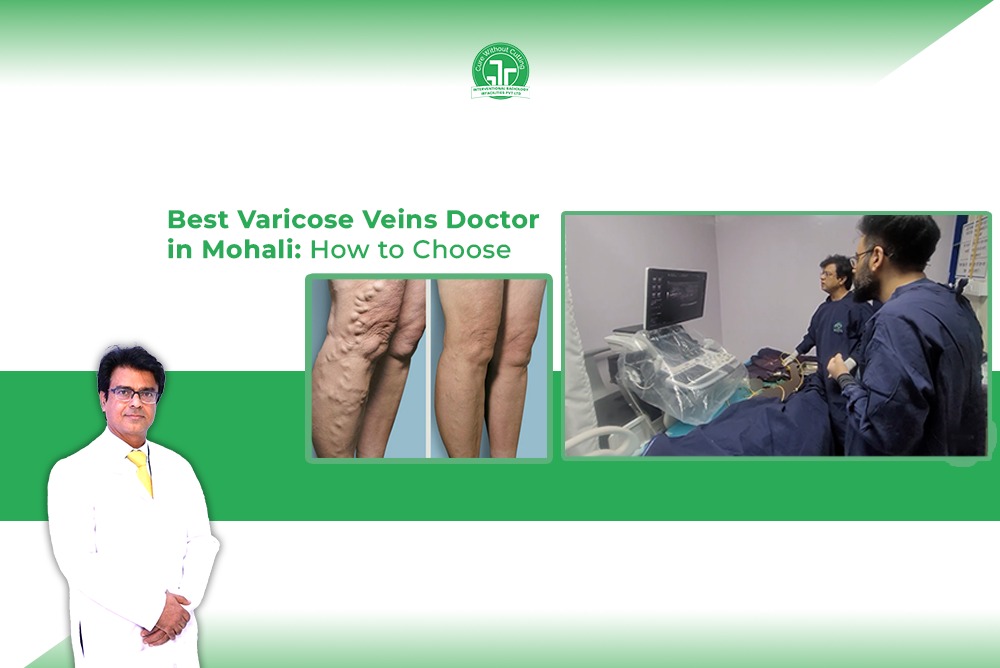
Best Varicose Veins Doctor in Mohali: How to Choose
If you have started noticing swollen or twisted veins on your legs, you may be wondering whether you actually need treatment or simply need to live with them. Varicose veins are quite common, but they can become uncomfortable over time. Some people notice aching and heaviness, while others develop swelling, itching or changes in the skin around the affected veins.
If you are searching for a varicose veins doctor in Mohali, don't choose a specialist only because a website says they are the "best." A better approach is to look at the doctor's experience, how they diagnose the problem, what treatments they offer and whether they explain your options clearly.
At IRFacilities, Sector 69, Mohali, Dr. Sandeep Sharma provides evaluation and minimally invasive treatment for varicose veins and other vein-related conditions.
What Causes Varicose Veins?
There are small valves inside the veins of your legs that help blood move upward toward the heart. When these valves become weak or stop working properly, some blood can flow backward and collect in the veins.
Over time, the increased pressure can cause the veins to become enlarged, twisted and more visible under the skin.
You may be more likely to develop varicose veins if you have a family history of the condition, spend many hours standing, are overweight, are pregnant, or are getting older. In some people, however, there isn't one obvious reason.
Not everyone with varicose veins needs treatment. The important thing is to find out what is happening inside the veins before deciding what to do about it.
When Should You See a Vein Specialist?
A few visible veins may not be a major concern. However, it is worth getting them checked if you are experiencing symptoms such as:
- Aching or throbbing in the legs
- A feeling of heaviness, especially toward the end of the day
- Swelling around the ankles
- Itching or burning around the veins
- Darkening or other changes in the skin
- Large, twisted or rope-like veins
- Symptoms that become worse after standing for several hours
Sometimes the veins you can see on the surface are not the main source of the problem. This is one reason a proper examination is more useful than simply judging the veins by appearance.
Why Is a Doppler Ultrasound Important?
One of the first things to ask when visiting a varicose vein specialist is whether they assess the veins with Doppler ultrasound.
The scan allows the doctor to see how blood is moving through your veins and whether there is venous reflux, which means blood is flowing in the wrong direction because a valve isn't working properly.
It also helps identify which veins are affected.
This matters because treatment isn't the same for every patient. Someone with a few small surface veins may need a very different approach from someone who has a larger faulty vein deeper in the leg.
A good treatment plan should start with finding the cause, not with deciding on a procedure.
What Should You Look for in a Varicose Vein Doctor?
When comparing doctors in Mohali and the surrounding Chandigarh region, there are a few practical things worth checking.
Experience: Find out whether the doctor regularly performs vein procedures and has experience with image-guided treatments.
Proper diagnosis: The doctor should assess your symptoms and, where appropriate, use Doppler ultrasound before recommending a procedure.
Treatment choices: Ask what options are suitable for your particular veins. Depending on the situation, treatment may involve compression, sclerotherapy, laser treatment or, in some cases, surgery.
Clear communication: You should understand why a particular treatment has been suggested, what it involves, how much it is expected to cost and what recovery will be like.
Transparent pricing: Treatment costs can vary depending on the number of veins being treated and the complexity of the problem. In the Mohali-Chandigarh area, laser treatment may cost roughly ₹50,000 to ₹1,50,000, while sclerotherapy may be around ₹30,000 to ₹80,000. These are general estimates, not fixed prices.
Laser Treatment, Sclerotherapy or Surgery?
People often search for the "best" varicose vein treatment, but there isn't one procedure that suits everyone.
Laser ablation is commonly used to treat a faulty larger vein. A thin catheter is inserted into the vein and laser energy is used to close it. Blood can then travel through healthier veins. Because there is no large surgical incision, recovery is generally shorter than with traditional surgery.
Sclerotherapy is often used for smaller varicose veins or spider veins. A medication is injected into the affected vein, causing it to close gradually. More than one session may sometimes be needed.
Surgery is still an option in certain situations, particularly when the veins are extensive or when minimally invasive treatment isn't appropriate.
The important thing is not to pick the procedure first. The doctor should look at the ultrasound findings and recommend the treatment that makes sense for your particular vein problem.
What Is Recovery Like?
Recovery depends on the type of treatment you receive.
After a minimally invasive procedure, you can usually walk shortly afterward. Some people experience mild bruising, tightness or soreness for a few days. Your doctor may also recommend compression stockings for a period of time.
Many patients are able to return to their normal activities fairly quickly, although the exact recovery period varies.
The symptoms you came in with may also take some time to settle. Heaviness and swelling can improve gradually, while visible veins and skin discoloration may take longer to change.
Following the post-treatment instructions and attending follow-up appointments can help your doctor monitor your recovery.
Dr. Sandeep Sharma at IRFacilities, Mohali
Dr. Sandeep Sharma, MD, DM – Interventional Neuroradiology, has more than 20 years of experience in interventional radiology and has treated more than 10,000 patients through image-guided procedures.
At IRFacilities, patients with varicose veins can undergo clinical assessment and ultrasound-based evaluation before treatment is planned. When appropriate, minimally invasive options such as laser-based treatment may be considered.
The procedure and anesthesia used depend on the individual case. Many minimally invasive vein procedures can be completed without an overnight hospital stay.
IRFacilities is located at Shivalik Hospital, Sector 69, Mohali.
Frequently Asked Questions
1. Do all varicose veins need treatment?
Not necessarily. A few visible veins may not need immediate treatment. However, it's worth getting
checked if you notice aching, heaviness, swelling, itching, skin changes, or large rope-like veins,
especially if symptoms worsen after standing for long periods.
2. Why is Doppler ultrasound important before treatment?
A Doppler ultrasound shows how blood is flowing through your veins and helps detect venous reflux
(blood flowing backward due to a faulty valve). It identifies exactly which veins are affected,
so treatment is based on the actual cause rather than just how the veins look on the surface.
3. What's the difference between laser treatment, sclerotherapy, and surgery for varicose veins?
Laser ablation is typically used for larger faulty veins and involves closing the vein with a catheter
and laser energy. Sclerotherapy is generally used for smaller varicose or spider veins, using an
injected medication to close them gradually. Surgery is reserved for more extensive cases or when
minimally invasive options aren't suitable. The right choice depends on ultrasound findings, not personal preference.
4. What does recovery look like after varicose vein treatment?
Recovery depends on the procedure, but after minimally invasive treatments, most people can walk shortly afterward. Mild bruising, tightness, or soreness for a few days is common, and compression stockings may be recommended. Full improvement in symptoms like swelling and skin discoloration can take longer.
Ready to Discuss?
Share your symptoms and reports with our team. We help you understand whether you need treatment now or simple lifestyle changes and follow‑up.