Somewhere in the middle of the page — between the clinical abbreviations and the radiologist's signature — sits a phrase you were not expecting. Varicocele, Grade 2. Maybe Grade 1. Maybe Grade 3.
Your doctor circled it. Said it needs attention. And now you are here, trying to make sense of what that grade actually means for your body, your fertility, and what happens next.
Good. That instinct to understand — not just accept — is exactly right.
The Ultrasound Did Not Find a Problem. It Found an Answer.
Most men come into the scan room nervous. They leave with a report they cannot fully read.
Here is the reframe: varicocele grading radiology is not a diagnosis of doom. It is a precision tool. It tells your doctor — with real specificity — how enlarged the veins are, whether blood is flowing in the wrong direction, and how urgently something needs to be done.
Without that grade, treatment is a guess. With it, the clinical path becomes obvious.
The scan did its job. Now you need to understand what it found.
What Is Actually Happening Inside
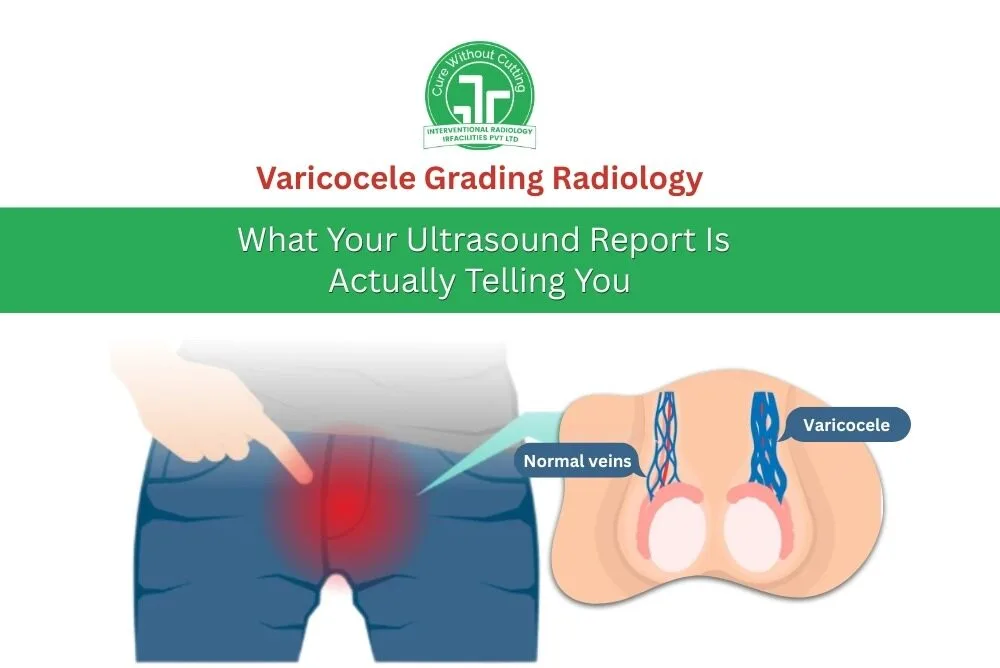
The testicles sit inside a network of thin veins called the pampiniform plexus. These veins carry blood upward, away from the scrotum, back toward the heart.
When the valves inside those veins weaken, blood stops moving up. It falls back. It pools.
That pooled blood raises scrotal temperature — even by just one or two degrees. That temperature increase is enough to disrupt sperm production, reduce motility, and over time, quietly shrink the testicle itself.
No dramatic symptom. No obvious warning. Just a slow, cumulative process that shows up years later in a fertility report — or in that persistent, unexplained ache on the left side that gets worse after a long day standing. Roughly 15% of all adult men have a varicocele. Among men investigated for infertility, that figure jumps to nearly 40%.
Most had no idea until varicocele grading radiology put a number to it.
How the Grading System Works
The standard test is a scrotal Doppler ultrasound. Painless. No radiation. Around 25 minutes from start to finish.
The radiologist is looking for two things:
Vein diameter: Below 2 mm is normal. Cross 3 mm — especially under physical strain — and it becomes a clinical finding worth taking seriously.
Venous reflux: In a healthy vein, blood travels upward. In a varicocele, it reverses. The radiologist checks for this reversal both at rest and during the Valsalva maneuver — that bear-down motion that increases abdominal pressure and forces the veins to reveal themselves.
The combination of diameter and reflux duration is what produces the grade.
Grade 1 Varicocele — Hidden, Not Harmless
You cannot see it. A doctor cannot feel it with their hands during a physical exam. Reflux only appears when the patient strains — not spontaneously. Vein diameter typically falls between 2.5 and 3 mm.
This is the grade that gets brushed aside most often. That is a mistake. For men with borderline semen analysis results, a Grade 1 varicocele can still be the silent factor pulling numbers down. Varicocele grading radiology catches what physical examination cannot — and that distinction matters enormously in fertility workups.
Grade 2 Varicocele — Felt, Not Seen
The veins are not visible through the skin. But a trained hand on examination can feel the abnormal fullness. Reflux shows up at rest, not just during straining. Diameter sits between 3 and 3.5 mm.
This is the most commonly diagnosed stage.
At Grade 2, the condition has moved past incidental. Semen parameters are often measurably affected by this point. The left-sided scrotal discomfort after standing for hours becomes a pattern you recognise. Treatment is no longer just something to consider — it becomes a conversation with a deadline.
Grade 3 Varicocele — Visible, Urgent, Treatable
No special maneuver needed here. Standing in front of a mirror, the distended, twisted veins are visible through the scrotal skin. Clinicians call it the bag of worms appearance — not a flattering description, but an accurate one.
Reflux is spontaneous. Vein diameter pushes past 3.5 mm, sometimes reaching 4 or 5 mm. The testicle is under constant pressure. Oxidative damage accumulates. In some men, the affected testicle begins to shrink — testicular atrophy — and that process does not reverse on its own once it starts.
Grade 3 found on varicocele grading radiology is not a watch-and-wait situation. It is an act-now situation.
The Grade Is a Decision, Not Just a Description
Here is what many patients miss. The number on the radiology report is not just labelling severity. It is telling your doctor what to do next.
Grade 1 with normal semen analysis — careful monitoring, yearly follow-up ultrasound.
Grade 1 or 2 with poor sperm parameters — interventional consultation, embolization discussion begins.
Grade 2 or 3 with pain, fertility issues, or both — treatment is appropriate. Delay costs you.
Grade 3, full stop — book the specialist appointment this week.
The grade also shapes how treatment is planned. It influences catheter approach during embolization. It sets expectations for recovery. It helps predict the timeline for sperm parameter improvement — which, in most treated cases, becomes measurable within three to six months post-procedure.
Surgery Is Not the Only Answer Anymore
For a long time, varicocelectomy — open surgery to cut or ligate the affected veins — was the standard response. It worked. But it meant general anaesthesia, an incision, a recovery period, and everything else that comes with going under the knife.
Varicocele embolization changed the equation.
An interventional radiologist makes a small nick — no scalpel, no sutures. A thin catheter is guided to the problem veins using live X-ray imaging. Those veins are sealed using coils or a sclerosing agent. Blood reroutes through healthy channels naturally.
You walk out the same day. Most men are back to their routine within 48 to 72 hours.
At IRFacilities, embolization is a well-established procedure — not experimental, not new. It is performed with meticulous pre-procedure planning, precision imaging, and genuine attention to recovery. Dr. Sandeep Sharma, with his extensive interventional radiology background, reviews each case individually — the grade, the symptoms, the fertility picture — before any treatment decision is made.
Your Next Step Depends on Your Grade
Grade 1, normal fertility — monitor annually, do not panic.
Grade 1 or 2, abnormal semen report — consult an interventional radiologist promptly.
Grade 2 or 3 with symptoms or fertility concerns — treatment is already overdue for some of you reading this.
Grade 3 — stop waiting. The window where intervention makes the most difference does not stay open indefinitely.
The report gave you a grade. The grade gives you direction. What you do with that direction is the part that actually changes things.
One Discipline. Diagnosis and Treatment, Both.
Here is something most patients learn too late.
The imaging specialty that graded your varicocele is the same specialty that treats it. Interventional radiology does not hand you off. It closes the loop — from diagnostic Doppler ultrasound through embolization planning to post-procedure follow-up.
At IRFacilities, the scan and the solution exist under one roof. No referral chain. No lost weeks between departments. The doctor who understands your imaging is the doctor guiding your treatment.
Bottom Line
Varicocele grading radiology is a precise, evidence-based system. It turns a vague symptom — or no symptom at all — into a specific clinical grade. And that grade tells you, clearly, where you stand and what needs to happen next.
Grade 1. Grade 2. Grade 3.
Each one is an answer. And answers, in medicine, are where the right treatment finally begins.
Ready to Discuss?
Share your symptoms and reports with our team. We help you understand whether you need treatment now or simple lifestyle changes and follow‑up.