Varicocele Embolization in Mohali: Non-Surgical Treatment for Varicocele Pain and Male Infertility
Do you feel a dull, heavy ache in the scrotum that gets worse after standing all day? Or have you and your partner been trying to conceive without success? The cause may be a varicocele. It is one of the most common and most treatable causes of male infertility.
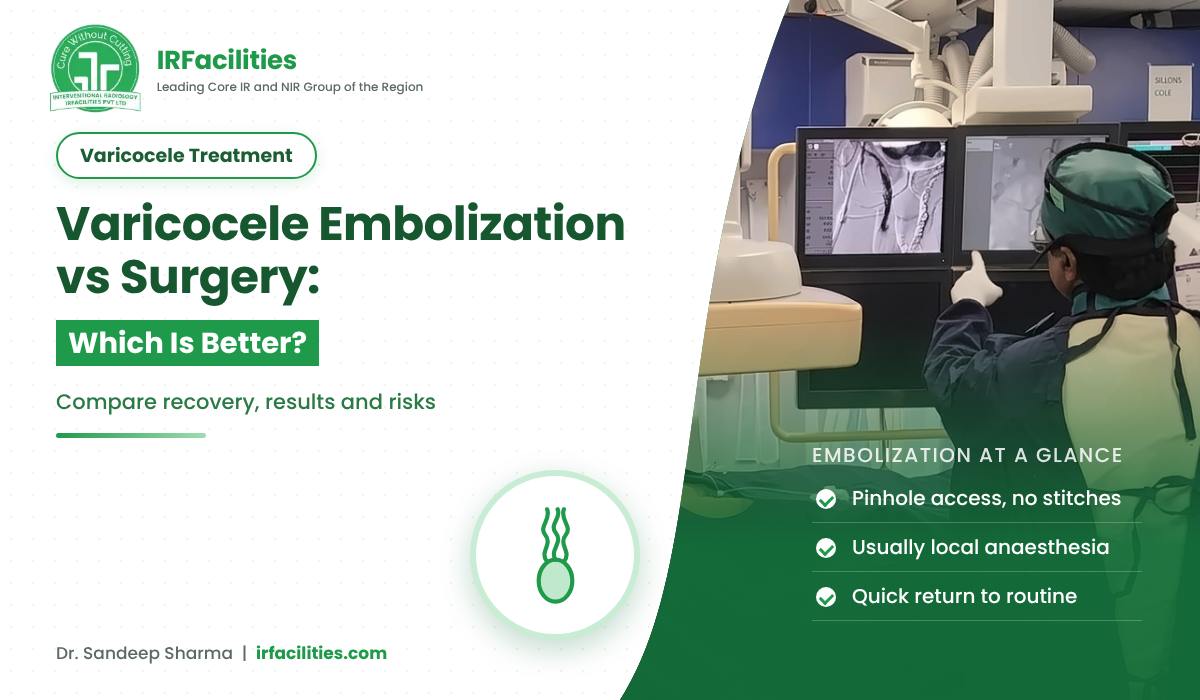
Today, many men no longer need open surgery for it. Varicocele embolization in Mohali is available at IRFacilities. The procedure is done through a pinhole in the skin, under local anaesthesia, and you usually go home the same day. This guide covers what a varicocele is, how embolization works, how it compares with surgery, and what to expect during recovery.
Quick facts: varicocele embolization
- Procedure time: about 45–60 minutes
- Anesthesia: local anesthesia, with mild sedation if needed
- Cut or stitches: none, only a pinhole entry in the groin or neck
- Hospital stay: day care, home in a few hours
- Back to desk work: usually in 1–2 days
- Performed by: an interventional radiologist
What is a varicocele?
A varicocele is a swelling of the veins inside the scrotum. It is like varicose veins in the legs. The small valves inside the testicular vein stop working properly, so blood flows backwards and pools around the testicle.
The pooled blood raises the temperature of the testicle and puts it under stress. Over time, this can affect sperm production and testosterone levels. About 15% of all men have a varicocele, and the figure rises to roughly 40% among men being checked for infertility. Around 90% of varicoceles are on the left side, because of the way the left testicular vein drains.
Symptoms you should not ignore
Many varicoceles cause no symptoms and are only found during a fertility check-up. When symptoms do appear, they include:
- A dull, dragging ache or heaviness in the scrotum, usually on the left side
- Pain that gets worse after standing, walking, exercise or hot weather, and eases when you lie down
- Swollen, twisted veins above the testicle that feel like a "bag of worms"
- One testicle that is smaller or softer than the other
- Difficulty conceiving, or a low sperm count, poor motility or abnormal sperm shape on semen analysis
A varicocele that appears suddenly, appears only on the right side, or does not shrink when you lie down should be checked promptly. These signs can point to another problem in the abdomen.
Grades of varicocele and when to treat
Doctors grade a varicocele by how easily it can be felt or seen:
- Subclinical (Grade 0): seen only on a Doppler ultrasound
- Grade 1: felt only when you strain or bear down
- Grade 2: felt easily while standing, but not visible
- Grade 3: clearly visible through the scrotal skin
Not every varicocele needs treatment. Your doctor will usually recommend it if:
- The pain affects work, exercise or sleep
- You are trying for a baby and the semen report is abnormal
- The affected testicle is shrinking, especially in teenagers and young men
- An earlier surgery did not work and the varicocele has come back
What is varicocele embolization?
Varicocele embolization is a minimally invasive treatment done by an interventional radiologist. This doctor treats diseases from inside the blood vessels, guided by live X-ray imaging.
The doctor does not cut open the groin. Instead, a very thin tube (catheter) travels through a vein to the faulty testicular vein. Tiny metal coils, or a special sclerosant (sealing) liquid, are placed there to close the vein. Blood then flows back to the heart through other, healthy veins. The swollen veins gradually shrink, the pressure and heat around the testicle fall, and the testicle can recover.
How the procedure is done, step by step
- Evaluation: a clinical exam, a scrotal Doppler ultrasound, and a semen analysis if fertility is a concern. Basic blood tests check kidney function and clotting.
- Preparation: you come in fasting for about 4–6 hours. A small area of the groin or neck is cleaned and numbed with local anaesthesia. You stay awake, and mild sedation can be given if you feel anxious.
- Access: a needle-sized puncture is made in the vein, and a thin catheter is passed through it.
- Venography: contrast dye is injected while the doctor watches on X-ray. This maps the faulty vein and any small side branches that could cause the varicocele to return.
- Embolization: coils and/or a sclerosant are placed to seal the abnormal vein and its branches.
- Finish: the catheter is removed and light pressure is applied. No stitches are needed, only a small dressing.
- Discharge: you rest for a few hours and go home the same day with simple pain medicines.
Living in Mohali, Chandigarh, Panchkula or Zirakpur? Talk to Dr. Sandeep Sharma about whether embolization is right for you. Call +91-8699977915 to book a consultation at IR Facilities, Sector 69, Mohali.
Varicocele embolization vs surgery
Surgery (open or microscopic varicocelectomy) and embolization have similar success rates. The main differences are in how the treatment is done and how quickly you recover.
- No cut: embolization needs only a pinhole puncture. Surgery needs an incision in the groin or lower abdomen.
- Lighter anaesthesia: embolization is done under local anaesthesia. Surgery usually needs general or spinal anaesthesia.
- Shorter stay: embolization is a day-care procedure, while surgery often means a one-day admission.
- Faster return to work: about 1–2 days after embolization, compared with about 1–2 weeks after surgery.
- No stitches or scar: embolization leaves only a tiny mark that fades. Surgery leaves stitches and a small scar.
- Lower risk of hydrocele (fluid build-up): embolization does not touch the lymph vessels, so this risk is very low. With surgery it is small but present.
- Similar recurrence: about 5–10% with embolization, comparable to surgery.
- Who suits which: embolization works well for most left-sided varicoceles, for varicoceles that return after surgery, and for men who want a quick recovery. Surgery may suit some bilateral cases, or cases where the vein anatomy is unsuitable.
The right choice depends on your anatomy, your fertility goals and whether both sides are affected. Your interventional radiologist and urologist can decide this together with you.
Recovery after varicocele embolization
- First 24 hours: rest at home. A mild ache in the groin or back is normal and settles with medicines.
- Days 1–2: return to desk work and light daily activity.
- Week 1: avoid heavy lifting, gym workouts, cycling and sex.
- Week 2 onwards: most men are back to full activity.
- Follow-up: a review visit and, for fertility patients, a repeat semen analysis at around 3 months.
Wear supportive underwear for a few days. Call your doctor if you have fever, increasing swelling or pain that does not settle.
Results: pain relief and fertility
The procedure succeeds technically in about 90% or more of cases. Most men notice less heaviness and pain within a few weeks, as the swollen veins shrink.
Fertility improves more slowly, because the body takes about three months to produce a new batch of sperm. Many men see better sperm count and motility on repeat tests at 3–6 months. For couples, this can mean a better chance of natural conception, or better results with IUI or IVF.
Risks and side effects
Varicocele embolization is considered a safe procedure. Possible side effects are uncommon and usually minor:
- Bruising or tenderness at the puncture site
- A temporary ache in the scrotum or groin (from the vein healing)
- Allergy to the contrast dye (rare; tell your doctor about any allergies)
- Coil movement out of place (very rare, and usually retrieved during the same sitting)
- Recurrence in about 5–10% of men, similar to surgery
Radiation exposure is kept as low as possible, and the testicles are shielded wherever possible.
Cost of varicocele embolization in Mohali
Published prices for varicocele embolization in India vary widely, from about ₹125,000 at smaller centres to over ₹1.5 lakh at large metro hospitals. Your final cost depends on:
- One side or both sides treated
- The type and number of coils or embolic material used
- Pre-procedure tests (Doppler ultrasound, blood tests, semen analysis)
- Health insurance coverage
Because embolization is a day-care procedure, you avoid long hospital stays and lost workdays. That lowers the overall cost. For an exact estimate, our team will share a clear, itemised quote after your consultation.
Why choose IR Facilities for varicocele embolization in Mohali?
IR Facilities is a dedicated interventional radiology centre. Image-guided, minimally invasive procedures are all we do.
- Led by Dr. Sandeep Sharma, MD, DM (Interventional Neuroradiology). He brings more than 20 years of experience in catheter-based, image-guided treatments.
- Specialist focus: embolization is a core skill of our team. It is not an occasional procedure here.
- Modern cath lab inside Shivalik Hospital, Sector 69, Mohali, with full hospital back-up.
- Day-care pathway: consultation, Doppler ultrasound, procedure and same-day discharge, with a clear plan at every step.
- Fertility-focused care: we work with your urologist or IVF specialist and track your semen results after treatment.
- Transparent pricing and help with insurance paperwork.
- Easy to reach from Mohali, Chandigarh, Panchkula, Zirakpur, Kharar and across Punjab and Himachal.
Ready to treat your varicocele without surgery? Book your consultation with Dr. Sandeep Sharma today. Call or WhatsApp +91-8699977915.
Frequently asked questions
Is varicocele embolization painful? No, it is usually not painful. The skin is numbed, and most patients feel only pressure. A mild ache for a day or two is common afterwards.
Will I need to stay in hospital? No. It is a day-care procedure, and most patients go home within a few hours.
Does embolization improve sperm count? In many men with an abnormal semen report, sperm count and motility improve within 3–6 months. Results vary from person to person.
Can a varicocele come back after embolization? It can, in about 5–10% of men. That is similar to surgery. Mapping all the side branches during the procedure lowers this risk.
Is embolization better than surgery? Both have similar success rates. Embolization avoids a cut and general anaesthesia and gives a faster recovery. Surgery may suit some bilateral cases better.
Can embolization be done if my earlier surgery failed? Yes. Embolization is often the preferred option for varicoceles that come back after surgery.
When can I go back to the gym? Usually after about one week. Your doctor will confirm this at the review visit.
Is varicocele embolization covered by insurance? It is a medically necessary procedure and many policies cover it. Our team can help check your policy before treatment.
Get varicocele treatment without surgery in Mohali
A varicocele is not something you have to live with, and it doesn't have to mean surgery. If you have scrotal pain or a fertility concern, an early check-up and a Doppler scan can tell you whether embolization is right for you.
IR Facilities, Mohali
3rd Floor, Shivalik Hospital, Japjee Dental Road, Sector 69, SAS Nagar (Mohali), Punjab 160062
Phone / WhatsApp: +91-8699977915
Timings: Monday–Saturday, 10:00 AM – 6:00 PM (Sunday emergencies only)
Ready to Discuss?
Share your symptoms and reports with our team. We help you understand whether you need treatment now or simple lifestyle changes and follow‑up.