Thyroid Nodule Treatment Without Surgery: Understanding Ablation Options
Being told that you have a thyroid nodule can be unsettling. The first thought for many people is, “Is it cancer?” or “Will I need surgery?” Fortunately, finding a thyroid nodule does not automatically mean that an operation is needed.
Many thyroid nodules are benign and never cause serious problems. Some only need to be checked from time to time with an ultrasound. But if a nodule becomes large, causes pressure in the neck, affects swallowing, or becomes noticeable from the outside, treatment may be considered.
Surgery is one option, but it isn't the only one. For certain benign thyroid nodules, image-guided thyroid ablation can be considered as a minimally invasive alternative.
Does Every Thyroid Nodule Need Treatment?
No. This is an important point.
A small nodule that isn't causing any symptoms may not need immediate treatment. Your doctor may recommend regular ultrasound examinations and thyroid blood tests instead.
Treatment may be discussed when a nodule:
- Continues to increase in size
- Creates a visible swelling in the neck
- Causes difficulty swallowing
- Produces pressure or discomfort around the throat
- Causes a persistent choking or tight feeling
- Produces excess thyroid hormone in suitable cases
- Becomes a cosmetic concern
The decision isn't based on size alone. The ultrasound appearance, biopsy results, symptoms and general health of the patient all need to be considered.
What Is Thyroid Ablation?
Thyroid ablation is a treatment that targets the unwanted tissue inside a thyroid nodule without removing the entire thyroid gland.
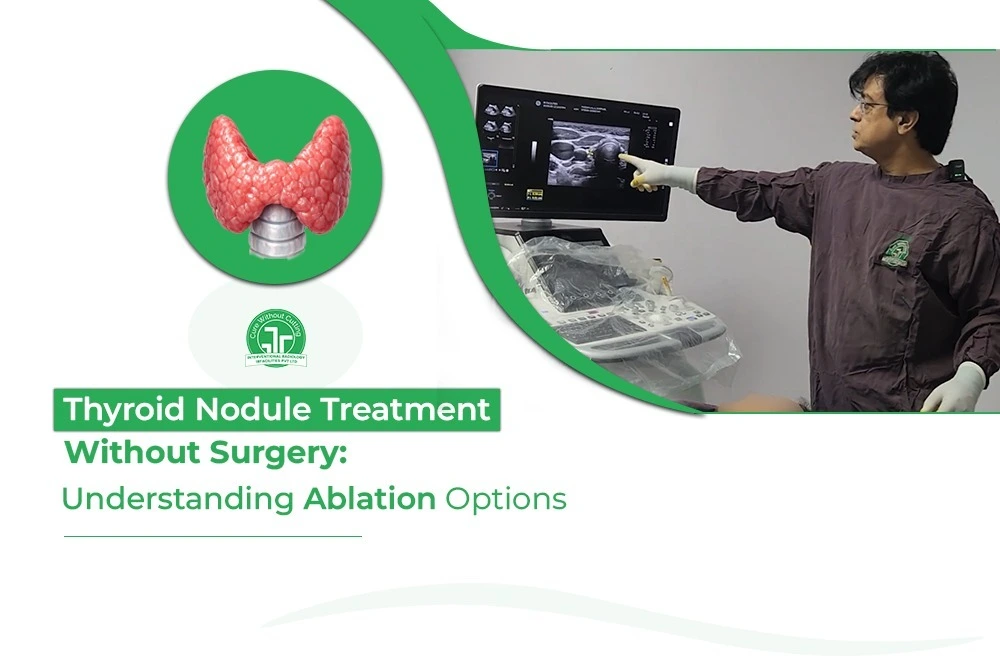
During the procedure, the doctor uses ultrasound to see the nodule on a screen. A thin probe is then carefully placed into the targeted area. Depending on the technique being used, controlled heat or another form of energy is delivered to the nodule.
The treated tissue is gradually broken down by the body. As time passes, the nodule becomes smaller.
It is worth remembering that the reduction doesn't happen overnight. Follow-up scans are used to see how the nodule is responding over the following months.
What Types of Thyroid Ablation Are Available?
Different ablation techniques are available. The most appropriate one depends on the type, size and position of the nodule.
Radiofrequency Ablation (RFA)
Radiofrequency ablation uses radiofrequency energy to heat the targeted tissue. It is commonly used for selected benign thyroid nodules.
As the treated tissue shrinks, patients may notice an improvement in symptoms caused by the nodule. The cosmetic appearance of a visible lump may also improve.
Microwave Ablation (MWA)
Microwave ablation uses microwave energy to heat the nodule. It may be considered for certain nodules, including some larger ones.
Whether MWA is appropriate depends on the individual nodule and its relationship with nearby structures.
Laser Ablation
Laser ablation uses laser energy delivered through a very small fibre. The doctor guides the fibre into the nodule with ultrasound and treats the selected tissue.
Ethanol Ablation
Ethanol ablation is mainly used for thyroid nodules that contain a significant amount of fluid.
In this procedure, ethanol is injected into the cystic part of the nodule. It can be particularly useful when the main problem is a fluid-filled thyroid cyst.
There isn't one technique that is right for everyone. The choice should be made after looking carefully at the patient's reports and the characteristics of the nodule.
Who May Be a Candidate for Thyroid Ablation?
Ablation is generally considered for selected patients whose thyroid nodules have been confirmed as benign and are causing problems.
For example, a patient may have a nodule that has become noticeable in the neck or is causing pressure while swallowing. Some people may also want treatment because they are uncomfortable with the appearance of a growing lump.
Before recommending ablation, the doctor may review:
- Thyroid ultrasound findings
- FNAC or other biopsy results
- Thyroid function tests
- The size and location of the nodule
- Symptoms experienced by the patient
- Whether the nodule is solid, cystic or mixed
Ablation is not suitable for every thyroid nodule. If a nodule is suspected to be cancerous or has other concerning features, surgery or another treatment may be recommended instead.
That is why proper diagnosis should come before deciding on ablation.
What Happens During Thyroid Ablation?
If you are considering ablation, it is natural to wonder what the procedure is actually like.
Before the procedure
Your doctor will review your medical history and test reports. Ultrasound is used to assess the nodule, while blood tests and FNAC may be required depending on the situation.
The doctor also looks at the position of the nodule and the important structures around the thyroid before planning the treatment.
During the procedure
Thyroid ablation is generally performed using local anesthesia. You remain awake while the doctor works with ultrasound guidance.
A thin probe is placed into the nodule and the selected tissue is treated. The exact duration can vary depending on the size and number of nodules being treated.
After treatment
Most patients can leave the hospital or clinic on the same day when there are no complications.
It is possible to have some soreness, mild swelling or tenderness around the treatment area. These symptoms generally settle with time.
Your doctor will advise you when you can return to your normal activities.
Follow-up
Follow-up is an important part of the treatment.
The thyroid nodule is usually checked with ultrasound at scheduled intervals. This allows the doctor to compare its size with the earlier scans and see how well it is responding.
The nodule normally becomes smaller gradually rather than immediately.
Thyroid Ablation vs Surgery
For an appropriate patient, one of the main attractions of ablation is that it can treat the nodule without surgically removing the thyroid.
Some potential advantages include:
- No traditional surgical incision
- No large neck scar
- Local anesthesia in many cases
- Usually a short recovery period
- Same-day discharge for many patients
- Preservation of much of the normal thyroid tissue
However, these advantages do not mean ablation is suitable for every patient. Surgery continues to have an important role in the treatment of certain thyroid nodules and cancers.
The safest approach is to first establish exactly what type of nodule you have and then discuss the available options with a specialist.
Are There Any Risks?
Thyroid ablation is minimally invasive, but it is still a medical procedure and does carry some risks.
You may experience temporary pain, tenderness, bruising or swelling around the neck after treatment. In uncommon cases, complications involving nearby structures can occur, including changes in the voice.
There is also a possibility that the nodule may not shrink as much as expected or may grow again later. Some patients may require additional treatment.
Careful ultrasound guidance and good knowledge of the anatomy around the thyroid are therefore important during the procedure.
Thyroid Nodule Ablation with Dr. Sandeep Sharma
When it comes to thyroid nodules treatment, it should begin with a proper assessment rather than simply deciding on a procedure.
Dr. Sandeep Sharma provides image-guided interventional treatment for patients who may be suitable for thyroid nodule ablation.
During consultation, the patient's symptoms, ultrasound findings, thyroid tests and biopsy reports can be reviewed. This helps determine whether monitoring, ablation or another treatment approach should be considered.
Patients can discuss:
- Whether their nodule is suitable for ablation
- Their ultrasound and FNAC reports
- Available treatment options
- What the procedure involves
- Expected recovery
- Follow-up after treatment
The aim is to choose an approach that fits the patient's condition rather than treating every thyroid nodule in the same way.
When Should You See a Specialist?
If you have noticed a lump in your neck or an ultrasound has found a thyroid nodule, don't assume that it automatically requires surgery.
Some nodules can simply be monitored. Others may need treatment because they are growing or causing symptoms.
If treatment is recommended, ask your doctor about all the available options. For selected benign thyroid nodules, thyroid ablation may offer a minimally invasive way to reduce the nodule while preserving much of the normal thyroid tissue,.
Ready to Discuss?
Share your symptoms and reports with our team. We help you understand whether you need treatment now or simple lifestyle changes and follow‑up.