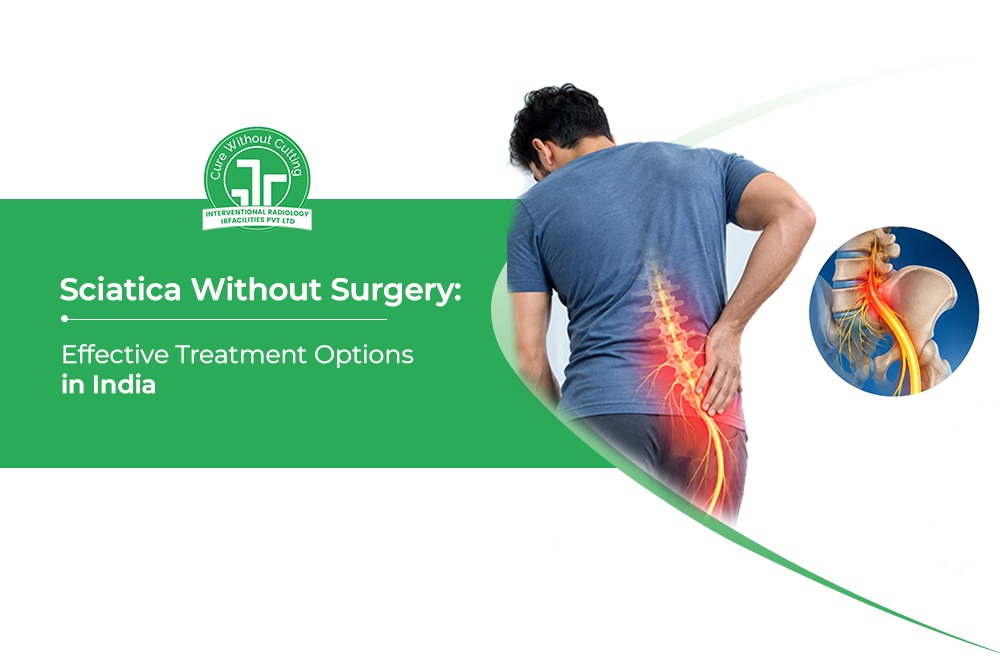
Sciatica Without Surgery: Effective Treatment Options in India
Back pain is common, but pain that starts in the lower back and then travels down the leg feels different. It can be sharp, burning, or like an electric shock. Sometimes there is tingling in the foot. At other times, the leg simply feels weak or heavy.
If you have experienced this, you may have heard the word sciatica.
And then comes the next worry: “Will I need surgery?”
Not necessarily.
Surgery is one of the treatment options for certain spinal problems, but it is not the starting point for every person with sciatica. Quite a few people get better with non-surgical treatment. For others, the pain may continue even after medicines and physiotherapy, and that is when a specialist may discuss other options.
The first thing is to understand what is actually causing the nerve pain.
What does sciatica feel like?
Sciatica generally affects one side of the body. The pain may begin around the lower back or buttock and then move down the thigh, calf or foot.
People describe it differently. Some say it feels like a burning sensation. Some compare it to pins and needles. Others notice numbness or weakness along with the pain.
The reason is usually irritation or compression of one of the nerve roots in the lower spine.
A herniated disc is a common cause. The discs sit between the bones of the spine and act as cushions. If part of a disc pushes out and irritates a nearby nerve, pain can travel down the leg.
Age-related changes can cause similar problems. In some people, the space around the nerves becomes narrower. This can also lead to symptoms, particularly while standing or walking.
So, sciatica is really a description of the symptoms. Finding the underlying cause is the more important part.
Can sciatica be treated without surgery?
In many cases, yes.
The treatment usually depends on how severe the symptoms are and whether there is any nerve damage.
Someone with mild pain that has started recently may not need an invasive procedure at all. A doctor may recommend medicines for a limited period, appropriate physical activity and physiotherapy.
The idea is to allow the irritated nerve to settle while gradually getting the person back to normal movement.
Staying in bed all day may sound sensible when your back hurts, but prolonged bed rest is generally not helpful for uncomplicated sciatica. At the same time, this doesn't mean you should ignore severe pain and continue doing activities that make it worse.
There is a middle ground, and treatment should be adjusted according to the person's condition.
Physiotherapy and exercises
Physiotherapy can be an important part of recovery.
The exercises prescribed for sciatica aren't necessarily the same for everyone. A physiotherapist may work on flexibility, muscle strength, posture and the way you move.
For example, someone who spends eight or ten hours sitting at a desk may need advice about movement habits as well as exercises. Someone whose pain becomes worse while walking may need a different approach.
This is also why randomly choosing exercises from social media or YouTube isn't always a good idea.
If an exercise increases your leg pain, numbness or weakness, it should be discussed with a healthcare professional rather than simply pushed through.
What happens when the pain doesn't improve?
This is a common situation.
A person may have already tried medicines and physiotherapy but still be unable to sit comfortably, sleep properly or carry out normal work.
At this stage, the doctor may reassess the diagnosis. Sometimes an MRI is recommended to get a clearer picture of the discs, nerves and spinal canal.
If the symptoms and imaging findings point towards nerve irritation, an image-guided spinal injection may be considered in selected cases.
The medicine is delivered to a specific area around the affected nerve or within the epidural space, depending on the condition and procedure. Imaging guidance helps the doctor identify the intended area during treatment.
The purpose is generally to reduce inflammation and pain around the irritated nerve.
It is important not to think of an injection as a universal cure for sciatica. It may be useful for some patients and not appropriate for others.
What is the role of an interventional radiologist?
Many people are familiar with orthopaedic doctors, neurologists and neurosurgeons, but they may not know what an interventional radiologist does.
Interventional radiology involves performing certain procedures with the help of medical imaging. Instead of relying only on external examination, imaging can be used during a minimally invasive procedure to guide treatment towards a specific area.
For some patients with persistent spine-related pain, this can provide an option when conventional conservative treatment has not given enough relief.
At IR Facilities, Dr. Sandeep Sharma is an Interventional Radiologist who evaluates patients with spine-related pain and discusses minimally invasive treatment options where appropriate.
The assessment comes first. A procedure is not automatically recommended simply because a patient has sciatica or an abnormal MRI.
Does an MRI always show the reason for the pain?
Not necessarily.
An MRI can be very useful. It can show disc herniation, narrowing around a nerve and other structural changes in the spine.
But there is a catch.
Some people have disc bulges or age-related changes on an MRI without having any symptoms. So if a scan says “disc bulge,” it doesn't automatically mean that the disc is responsible for your leg pain.
A doctor needs to compare the MRI findings with your symptoms and physical examination.
This is one reason why treating the report instead of treating the person can sometimes lead to unnecessary procedures.
When should you see a doctor?
If the pain is mild and improving, it may settle with appropriate conservative care.
But persistent pain should not simply be ignored, particularly when it is interfering with normal life.
You should seek medical attention promptly if you develop symptoms such as:
- Increasing weakness in the leg
- Loss of bladder or bowel control
- Numbness around the genital or inner-thigh area
- Severe or rapidly worsening symptoms
- Significant back pain after an injury
- Fever along with severe back pain
These symptoms need proper medical assessment because they can sometimes indicate a more serious spinal or neurological problem.
Is surgery ever necessary?
Yes, in some situations.
The point of non-surgical treatment is not to say that surgery is never required. Some people have significant nerve compression or neurological problems where surgery may be the appropriate treatment.
For others, there is no immediate reason to operate.
The decision depends on the cause, severity of symptoms, neurological examination, imaging findings and response to previous treatment.
In other words, an MRI showing a disc problem does not by itself answer the question of whether surgery is required.
How can you reduce the chance of another episode?
Unfortunately, nobody can promise that sciatica will never return.
Still, once the painful phase has settled, staying active is generally useful. Strengthening the muscles around the trunk and improving flexibility may help with overall back function.
If you sit for long periods, don't stay in the same position for hours without moving. If a particular activity repeatedly triggers your symptoms, discuss it with your doctor or physiotherapist instead of simply accepting the pain as normal.
Small habits matter over time.
A practical approach to sciatica treatment
If you are dealing with sciatica, it can be tempting to search online for the fastest treatment.
But the fastest-looking option isn't necessarily the right one.
A sensible approach is to first establish the likely cause of the symptoms. From there, treatment can progress step by step.
For one person, physiotherapy and time may be enough.
For another, medicines may be required for a short period.
Someone with persistent nerve pain may be evaluated for an image-guided procedure.
And in specific cases, surgery may eventually be discussed.
There is no single treatment pathway that fits everyone.
Sciatica treatment at IR Facilities
At IR Facilities, Dr. Sandeep Sharma, Interventional Radiologist, evaluates patients who are experiencing sciatica, back pain and pain travelling into the leg.
The focus is on understanding the source of the symptoms and reviewing the available clinical and imaging information before discussing treatment.
For suitable patients, minimally invasive, image-guided treatment options may be considered.
If you have been living with persistent sciatica and are worried that surgery is your only option, a specialist evaluation can help you understand the alternatives that may be available in your particular case.
Frequently Asked Questions
Can sciatica go away on its own?It can. Some cases improve with time and conservative treatment. However, persistent, worsening or severe symptoms should be evaluated by a medical professional.
Can I treat sciatica without surgery?Many people can be treated without surgery. Depending on the cause, options may include medicines, physiotherapy, activity modification and, for selected patients, image-guided procedures.
Is an injection suitable for everyone with sciatica?No. An image-guided injection is considered only when the clinical situation suggests that it may be useful. A proper evaluation is needed before deciding.
Does a slipped disc mean I need an operation?Not automatically. Many herniated discs can be managed without surgery. The need for surgery depends on symptoms, neurological findings and how the condition responds to treatment.
Who should I consult for minimally invasive sciatica treatment?An interventional radiologist can evaluate whether an image-guided procedure is appropriate for certain causes of nerve-related pain. Dr. Sandeep Sharma at IR Facilities provides evaluation and discusses suitable minimally invasive options.
Final word
Sciatica can be painful enough to change the way you work, sleep and move through the day. But hearing “nerve compression” or “slipped disc” does not mean that an operation is automatically waiting for you.
There are several non-surgical approaches that may be considered first.
The important part is getting the diagnosis right and choosing treatment according to the actual problem.
If your leg pain has been continuing despite usual treatment, speak with a specialist rather than continuing to manage it on your own.
Dr. Sandeep Sharma, Interventional Radiologist at IR Facilities, can evaluate your condition and explain whether conservative care or a minimally invasive image-guided treatment may be appropriate for you.
Ready to Discuss?
Share your symptoms and reports with our team. We help you understand whether you need treatment now or simple lifestyle changes and follow‑up.