Peripheral Arterial Disease (PAD): Symptoms, Treatment and Angioplasty in Mohali
Have you started getting pain in your legs after walking for a while? Maybe you notice that your calf starts aching when you walk to the market or climb stairs, but the pain settles down once you sit and rest.
It may seem like a normal part of getting older. Sometimes it is. But in some people, this kind of pain is related to poor blood circulation in the legs.
One possible cause is Peripheral Arterial Disease, or PAD.
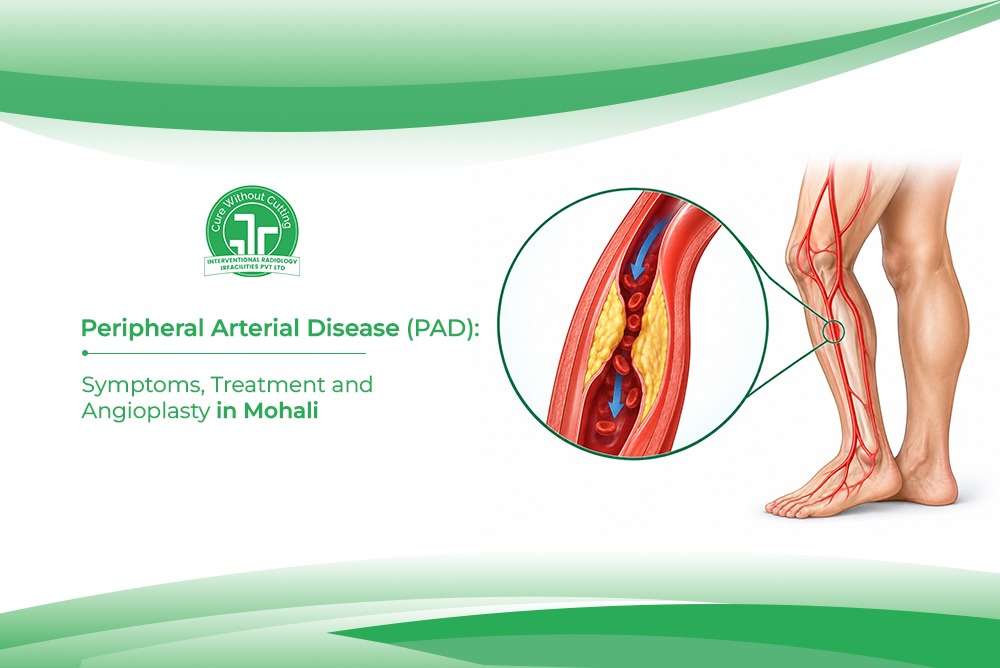
PAD develops when the arteries that carry blood to the legs become narrow or blocked. As a result, the muscles may not get enough blood when they need it, particularly during walking or physical activity.
For people looking for PAD treatment in Mohali, it is important to first understand what is causing the reduced blood flow. Treatment isn't the same for everyone. In some cases, medicines and lifestyle changes are enough. In others, a minimally invasive procedure such as peripheral angioplasty may be considered.
What is Peripheral Arterial Disease (PAD)?
Peripheral Arterial Disease is a circulation problem that usually affects the arteries supplying the legs and feet.
Over time, fatty deposits can build up inside an artery. The passage through which blood flows becomes narrower. When you are resting, the available blood flow may still be enough. But when you walk, your muscles need more oxygen-rich blood. That's when the symptoms can become noticeable.
A person may walk a certain distance, start feeling pain or heaviness in the calf, stop for a few minutes, and then feel better.
This pattern is quite common in PAD.
However, not everyone experiences obvious pain. Some people have numbness, cold feet or wounds that take unusually long to heal. Others may have very few symptoms in the beginning.
That is why persistent changes in the legs or feet shouldn't simply be ignored.
What Are the Symptoms of PAD?
PAD doesn't look exactly the same in every patient. Some people notice the problem while walking, while others first notice changes in their feet.
Here are some symptoms worth paying attention to:
- Pain or cramping in the calf, thigh or hip while walking
- Leg pain that improves after stopping and resting
- A feeling of heaviness or tiredness in the legs
- One foot feeling colder than the other
- Numbness or tingling in the legs or feet
- Changes in the colour of the skin
- Slow-growing toenails or reduced hair growth on the legs
- Cuts, ulcers or wounds on the foot that take longer to heal
One thing that can make PAD confusing is that its symptoms can look like other common problems. A person may think the pain is because of arthritis, a nerve issue or simply age.
If the same leg pain keeps coming back whenever you walk, it's better to get it checked rather than guessing at the cause.
How Is PAD Treated?
Treatment depends on how severe the disease is and where the artery is narrowed or blocked.
For some patients, treatment starts with medicines, regular physical activity, controlling blood sugar and blood pressure, improving cholesterol levels and stopping smoking.
But when blood flow is significantly restricted or symptoms continue despite other treatment, a vascular intervention may be recommended.
Peripheral angioplasty is one of the minimally invasive options used in suitable patients.
During the procedure, a thin catheter is guided through the blood vessel to the narrowed area. A small balloon can then be used to open the narrowed section and improve blood flow. In certain cases, a stent may also be placed.
Not every patient needs a stent. The decision depends on the location and nature of the blockage and the findings during evaluation.
Why Choose Dr. Sandeep Sharma for PAD Treatment in Mohali at IRFacilities?
When someone is told that an artery in the leg is blocked, the first concern is usually quite simple: What can be done about it, and how much time will I need to recover?
Dr. Sandeep Sharma at IRFacilities provides minimally invasive, image-guided treatment options for patients who may be suitable for interventional procedures.
The treatment plan starts with understanding the patient's symptoms and looking at the available imaging. From there, the doctor can discuss whether angioplasty or another treatment approach makes sense.
The aim is not to perform a procedure simply because it is available. It is to choose an option that fits the patient's condition.
Treatment without a surgical cut
This is one of the reasons patients ask about angioplasty.
Peripheral angioplasty is performed through a small catheter access point rather than the large incision associated with open surgery. There is generally no large surgical cut and, in many cases, no stitches like those used after traditional surgery.
That can make the recovery process easier for suitable patients.
Around one hour in some cases
People often ask how long the procedure takes.
Some peripheral angioplasty procedures can be completed in around an hour, but there isn't one fixed time for every patient. A straightforward blockage may take less time, while a more complicated case can require longer.
The doctor can give you a better idea after reviewing your scans and understanding the exact blockage.
Can you go home the same day?
In selected cases, patients may be able to go home on the same day after the procedure and the required observation period.
For others, an overnight stay may be recommended.
It depends on the procedure, the patient's overall health and how they are doing after treatment. The important thing is making sure the patient is stable before discharge.
Advantages of Peripheral Angioplasty
For the right patient, angioplasty can offer several practical benefits.
Minimally Invasive
There is no need for the type of large surgical incision used in open arterial surgery. A catheter is used to reach the affected artery and treat the narrowing from inside the blood vessel.
Because the access is small, there may be less tissue trauma and a smaller wound to look after.
Shorter Recovery
Nobody wants to spend more time in a hospital than necessary.
Compared with major open surgery, minimally invasive angioplasty can allow many suitable patients to recover more quickly. Some patients can return home within 24 hours, although the actual hospital stay depends on the individual case.
Your doctor will advise you about walking, work and other normal activities after the procedure.
Better Blood Flow to the Leg
The purpose of angioplasty is straightforward: improve blood flow through the narrowed artery.
When the reduced circulation is responsible for walking-related pain or tiredness, improving blood flow may help reduce these symptoms. Patients may find that everyday activities become easier once circulation improves.
The result can be particularly meaningful for someone who has gradually stopped walking or doing normal activities because of leg pain.
When Should You Get Your Leg Pain Checked?
A little tiredness after a long walk isn't necessarily a sign of PAD.
But if you repeatedly develop calf or thigh pain while walking, if the pain settles after resting, or if you notice cold feet, colour changes or a wound that isn't healing properly, don't keep putting it off.
This is especially important if you have diabetes, high blood pressure, high cholesterol or a history of smoking.
A simple evaluation can help identify whether the problem is related to circulation, nerves, joints or something else.
For patients who need Peripheral Arterial Disease treatment in Mohali, Dr. Sandeep Sharma at IRFacilities can evaluate the condition and discuss whether a minimally invasive treatment such as peripheral angioplasty is appropriate.
Ready to Discuss?
Share your symptoms and reports with our team. We help you understand whether you need treatment now or simple lifestyle changes and follow‑up.