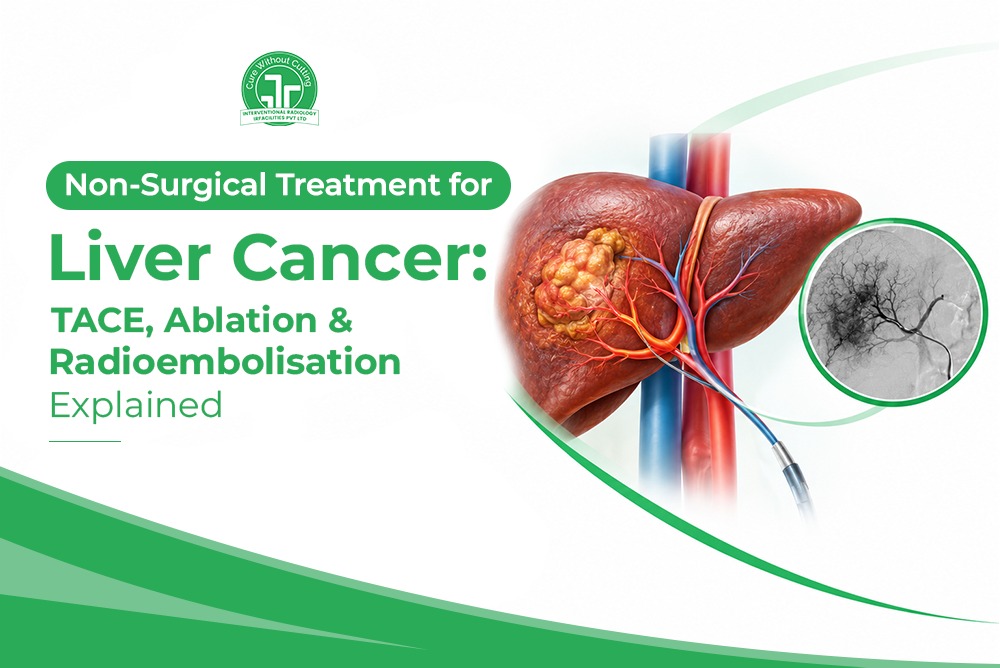
Non-Surgical Treatment for Liver Cancer: TACE, Ablation & Radioembolisation Explained
Liver cancer treatment has advanced significantly, and surgery is not the only option available for every patient. Depending on the type, size, number and location of tumours, as well as the overall health and function of the liver, doctors may consider minimally invasive, non-surgical treatments.
Three important interventional radiology treatments used in selected patients with liver cancer are Transarterial Chemoembolization (TACE), tumour ablation, and Transarterial Radioembolisation (TARE), also known as radioembolisation or SIRT.
These treatments target the tumour while aiming to preserve as much healthy liver tissue as possible. The appropriate treatment depends on individual factors and is usually decided after detailed imaging, blood tests and specialist assessment.
What Is Non-Surgical Treatment for Liver Cancer?
Non-surgical or minimally invasive liver-cancer treatments are procedures performed through needles or small catheters rather than through conventional open surgery.
The main approaches include:
- Radiofrequency Ablation (RFA): Uses heat generated by radiofrequency energy to destroy cancer cells.
- Microwave Ablation (MWA): Uses microwave energy to heat and destroy tumour tissue.
- TACE: Delivers chemotherapy directly to the tumour's blood supply and simultaneously blocks that blood supply.
- Radioembolisation/TARE: Delivers tiny radioactive microspheres through the tumour's arterial blood supply.
These treatments may be used for local tumour control, reducing tumour burden, bridging selected patients to liver transplantation, or treating disease that is not suitable for surgical removal.
What Is Radiofrequency Ablation?
Radiofrequency Ablation (RFA) is a minimally invasive treatment that uses heat to destroy cancer cells.
During the procedure, an interventional radiologist guides a thin needle-like electrode into the liver tumour, usually with the help of ultrasound or CT imaging. Radiofrequency energy is then delivered through the electrode, generating heat that destroys the targeted tumour tissue.
RFA is generally most effective for selected small liver tumours. Tumour size, location, liver function and proximity to blood vessels or other organs all influence whether ablation is suitable.
Microwave ablation (MWA) is another thermal technique. It uses electromagnetic energy to heat the tumour and can create a larger treatment zone in certain situations.
Advantages of Liver Tumour Ablation
For appropriately selected patients, ablation can offer several potential benefits:
- Minimally invasive treatment through a small skin puncture.
- No large surgical incision.
- Ability to directly target the tumour using image guidance.
- Potential preservation of surrounding healthy liver tissue.
- Often a shorter recovery period than major liver surgery.
- May be considered when surgery is unsuitable for certain patients.
- Can be used for selected recurrent or residual liver tumours.
However, ablation is not appropriate for every liver tumour. Tumours close to major blood vessels, bile ducts or other sensitive structures may present additional technical challenges. The size and number of tumours and the patient's liver function also need to be considered.
Who Should Consider Non-Surgical Liver Cancer Treatment?
Non-surgical treatment may be considered for selected patients with liver cancer when conventional surgery is not appropriate or when a local treatment is clinically suitable.
Potential candidates may include patients with:
- Small, localized liver tumours suitable for ablation.
- Intermediate-stage hepatocellular carcinoma that may be treated with TACE.
- Tumours that are difficult to remove surgically.
- Liver cancer where preserving functioning liver tissue is particularly important.
- Recurrent or residual disease in selected circumstances.
- Disease being treated as part of a strategy before liver transplantation or another definitive treatment.
TACE is commonly used for selected patients with intermediate-stage liver cancer, while ablation is particularly relevant for appropriately selected small tumours. Radioembolisation may also be considered as a locoregional treatment in suitable patients.
Treatment suitability cannot be determined from tumour size alone. Liver function, tumour location, vascular involvement, overall health and whether the cancer has spread outside the liver must all be assessed.
What Is TACE?
Transarterial Chemoembolization (TACE) is a catheter-based treatment for selected liver cancers.
A thin catheter is introduced into an artery and carefully guided into the blood vessel supplying the tumour. Chemotherapy is then delivered directly to the tumour's arterial blood supply along with embolic material that reduces or blocks blood flow to the tumour.
Because liver tumours such as hepatocellular carcinoma receive much of their blood supply from the hepatic artery, TACE can concentrate treatment around the tumour while reducing its arterial blood supply.
TACE is generally used for carefully selected patients, particularly those with intermediate-stage hepatocellular carcinoma who are not candidates for curative surgery or ablation. It may also have a role in downstaging or bridging selected patients being evaluated for liver transplantation.
What Is Radioembolisation?
Transarterial Radioembolisation (TARE), commonly called radioembolisation or SIRT, is another minimally invasive catheter-based treatment.
During radioembolisation, tiny radioactive microspheres are delivered through the hepatic artery and become concentrated within the tumour's blood supply. These microspheres deliver radiation locally, damaging tumour cells and the blood vessels that support tumour growth.
One commonly used radioactive substance is Yttrium-90 (Y-90).
Radioembolisation may be considered for selected patients with liver cancer when a tumour-directed arterial treatment is appropriate. Its suitability depends on tumour characteristics, liver function, vascular anatomy and other clinical factors.
How Is Liver Tumour Ablation Performed?
Before treatment, imaging such as CT or MRI is used to assess the tumour and determine the safest treatment approach.
During ablation:
- The patient is positioned and monitored.
- Local or general anaesthesia or sedation may be used depending on the procedure and clinical circumstances.
- Imaging guidance is used to accurately target the tumour.
- An ablation probe is inserted into the tumour.
- Radiofrequency or microwave energy is delivered.
- The generated heat destroys the targeted tumour tissue.
- The probe is removed and the patient is monitored during recovery.
The exact technique varies according to the tumour's size, location and relationship to nearby structures.
Recovery After Treatment
Recovery depends on the treatment performed and the patient's overall health.
After ablation, many patients can be monitored for a relatively short period before returning home, although some may require overnight observation.
After TACE or radioembolisation, patients are also monitored for possible treatment-related symptoms and complications. Temporary fatigue, abdominal discomfort, nausea or fever can occur after some locoregional treatments.
TACE can cause post-embolization syndrome, which may include abdominal pain, nausea and fever. More serious complications, including liver dysfunction, bleeding, infection or injury to nearby organs, are possible but vary according to the patient's condition and the procedure.
Follow-up imaging and blood tests are important after treatment to assess the response and determine whether additional treatment is required.
What Are the Advantages of Non-Surgical Liver Tumour Ablation?
When appropriately selected, minimally invasive liver tumour treatments may provide important benefits:
- Less invasive than major liver surgery
- Small access point rather than a large surgical incision
- Image-guided precision
- Potential preservation of healthy liver tissue
- Useful for selected patients who are not suitable for surgery
- Can be incorporated into a broader liver-cancer treatment plan
- May be repeated or combined with other treatments in selected cases
These benefits need to be balanced against the patient's individual risks. Non-surgical treatment is not automatically suitable for every patient. The appropriate treatment depends on the individual clinical situation.
Why Choose an Interventional Approach?
Interventional radiology provides image-guided treatments that can target liver tumours through small access points. For suitable patients, these procedures can form an important part of a multidisciplinary liver-cancer treatment plan.
A patient's treatment plan may involve an interventional radiologist together with a hepatologist, medical oncologist, liver surgeon, radiation specialist and other healthcare professionals.
This collaborative approach helps determine whether ablation, TACE, radioembolisation, surgery, transplantation, systemic therapy or a combination of treatments is appropriate.
Final Thoughts
A diagnosis of liver cancer does not automatically mean that major surgery is the only treatment option. Ablation, TACE and radioembolisation provide important minimally invasive treatment approaches for carefully selected patients.
The right procedure depends on the type and stage of liver cancer, tumour size and location, liver function, blood-vessel involvement, overall health and previous treatments.
If you or a family member has been diagnosed with liver cancer, discuss the available treatment options with a qualified liver-cancer specialist and ask whether an interventional radiology procedure may be suitable.
Ready to Discuss?
Share your symptoms and reports with our team. We help you understand whether you need treatment now or simple lifestyle changes and follow‑up.