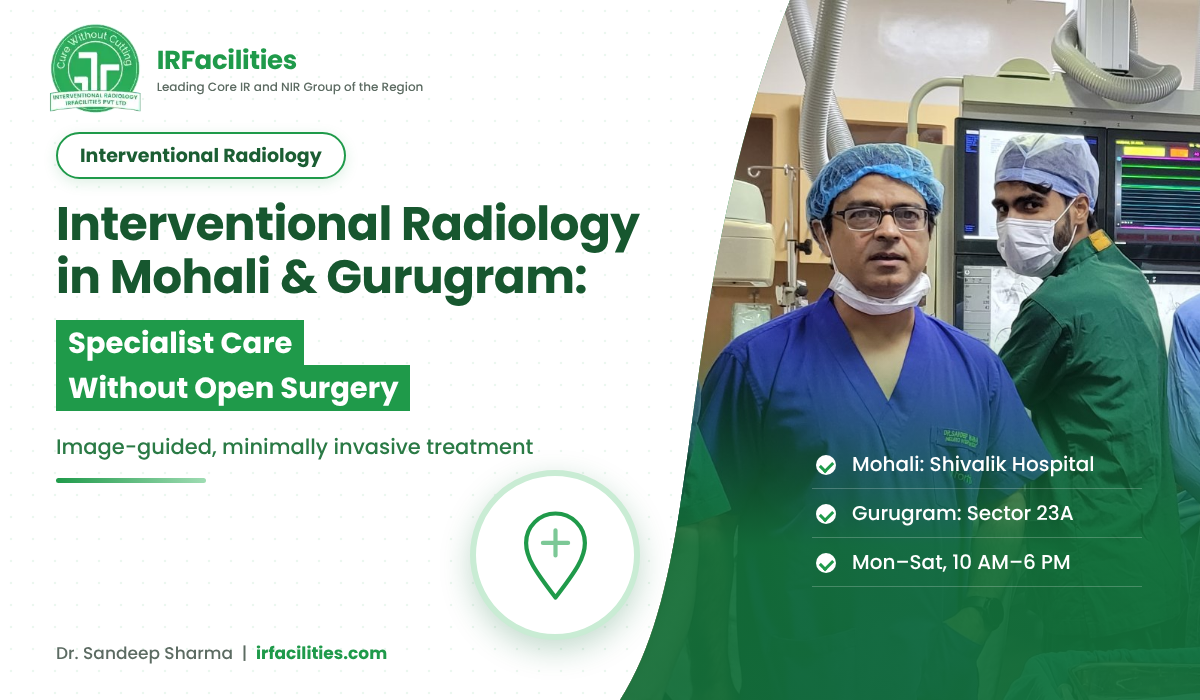
Interventional Radiology in Mohali & Gurugram: Specialist Care Without Open Surgery
When you or someone you love needs treatment for a blocked blood vessel, a brain bleed, painful varicose veins or a fibroid, the first word you often hear is surgery. For many of these conditions, there is another option.
Interventional radiology (IR) treats disease from the inside, through a pinhole. Using live X-ray, ultrasound or CT images as a guide, a specialist passes a thin tube (catheter) or needle through a small puncture in the skin, usually at the wrist or groin, and treats the problem directly. No large cuts, no stitches, and often no long hospital stay.
IR Facilities now has two dedicated centres, in Mohali and Gurugram, so patients across Punjab, Haryana, Chandigarh and Delhi NCR can get this care close to home.
Why choose a dedicated IR centre?
Most large hospitals offer interventional radiology as one department among many. At IR Facilities, it is all we do. That focus makes a difference to patients in a few ways:
- You see the specialist directly. Your consultation is with an interventional radiologist from the start. You aren't passed between departments before someone explains your options.
- Neuro-intervention expertise. Our centres are led by Dr. Sandeep Sharma, MD, DM (Interventional Neuroradiology), a super-specialist trained to treat the brain and spine through blood vessels. That matters for strokes, aneurysms and brain bleeds, where minutes count.
- A plan built around you. Every treatment plan starts from your scans and a full clinical review, not a standard package.
- Emergency support. Stroke and bleeding emergencies are handled 7 days a week, including Sundays.
What we treat
Brain and neuro conditions
- Acute stroke (clot removal)
- Brain aneurysms (coiling and flow diverters)
- Brain haemorrhage and subarachnoid haemorrhage, including vasospasm management
- AVMs (abnormal blood vessel tangles)
- Carotid artery narrowing (stenting)
Vascular conditions
- Varicose veins
- Varicocele
- Peripheral artery disease (poor blood flow to the legs)
- Portal hypertension (TIPS, BRTO)
- Internal bleeding (embolisation)
Cancer care
- Liver cancer and liver metastases, treated directly through the blood supply to the tumour
Women's and men's health
- Uterine fibroid embolisation, a non-surgical alternative to hysterectomy for many women
- Prostate artery embolisation for enlarged prostate
Pain and other procedures
- Genicular artery embolisation for knee arthritis pain
- Spine and pain management
- Thyroid nodule treatment
- Haemorrhoid embolisation
- Image-guided biopsies, abscess and fluid drainage, biliary procedures
How IR compares with open surgery
Every patient is different, and not every condition suits IR. Where it is suitable, patients typically benefit from:
- A small needle puncture instead of a surgical incision
- Less pain and less blood loss
- A shorter hospital stay, often going home the same or next day
- A faster return to work and daily life
- No stitches and no visible scar
Your doctor will discuss whether IR, surgery or medicine is the right choice for you.
Our Mohali centre: serving Chandigarh Tricity
Address: 3rd Floor, Shivalik Hospital, Sector 69, SAS Nagar, Mohali, Punjab
Our Mohali centre serves patients from Mohali, Chandigarh, Panchkula and Zirakpur, as well as referrals from across Punjab and Himachal Pradesh. Being inside a hospital means full support is on hand for patients who need admission after their procedure.
If you're searching for an interventional radiologist in Mohali or a neuro-interventional specialist near Chandigarh, you can book a consultation directly.
Our Gurugram centre: serving Delhi NCR
Address: Near Manipal Hospital, Sector 23A, Gurugram, Haryana
Our newest centre brings the same specialist-led care to Gurugram, Delhi and the wider NCR. Patients from Gurugram, Manesar, Dwarka and South Delhi can reach us easily for consultations, planned procedures and emergency stroke care.
Stroke and brain bleeds: act fast
In a stroke, brain cells are lost every minute the blood supply is blocked. Clot removal through a catheter (mechanical thrombectomy) works best when done early.
Call for help immediately if you notice BE FAST signs:
- Balance loss
- Eyes: sudden vision loss
- Face drooping
- Arm or leg weakness
- Speech difficulty
- Time to call for help
A sudden, severe "worst-ever" headache can be a sign of a brain bleed and also needs emergency care.
Questions to ask before choosing an interventional radiologist
Whether you choose us or another centre, these questions will help you make a confident decision:
- Is the doctor a trained interventional radiologist, and for brain procedures, a neuro-interventional specialist?
- How often does the team perform the procedure you need?
- Will you meet the doctor who will actually do your procedure?
- Is emergency support available if something happens after hours or on a Sunday?
- What will recovery look like, and when can you go home?
- Has the team explained the alternatives, including surgery and medication?
Frequently asked questions
Is interventional radiology painful? Most procedures are done under local anaesthesia with light sedation. Patients usually feel only a small pinch at the puncture site.
How long does recovery take? It depends on the procedure, but many patients go home within a day and return to normal activity within a few days.
Do I need a referral? No. You can book a consultation directly at either centre. Bring any recent scans and reports.
Is IR covered by insurance? Many IR procedures are covered by health insurance. Our team can guide you on documentation.
Which centre should I visit? Choose Mohali if you live in the Chandigarh Tricity or Punjab, and Gurugram if you're in Delhi NCR. Both offer the same specialist-led care.
Book a consultation
Hours: Monday to Saturday, 10 AM – 6 PM
📞 +91-86999 77915 ✉️ irfacilities2025@gmail.com
Mohali: 3rd Floor, Shivalik Hospital, Sector 69, SAS Nagar
Gurugram: Near Manipal Hospital, Sector 23A
Ready to Discuss?
Share your symptoms and reports with our team. We help you understand whether you need treatment now or simple lifestyle changes and follow‑up.