
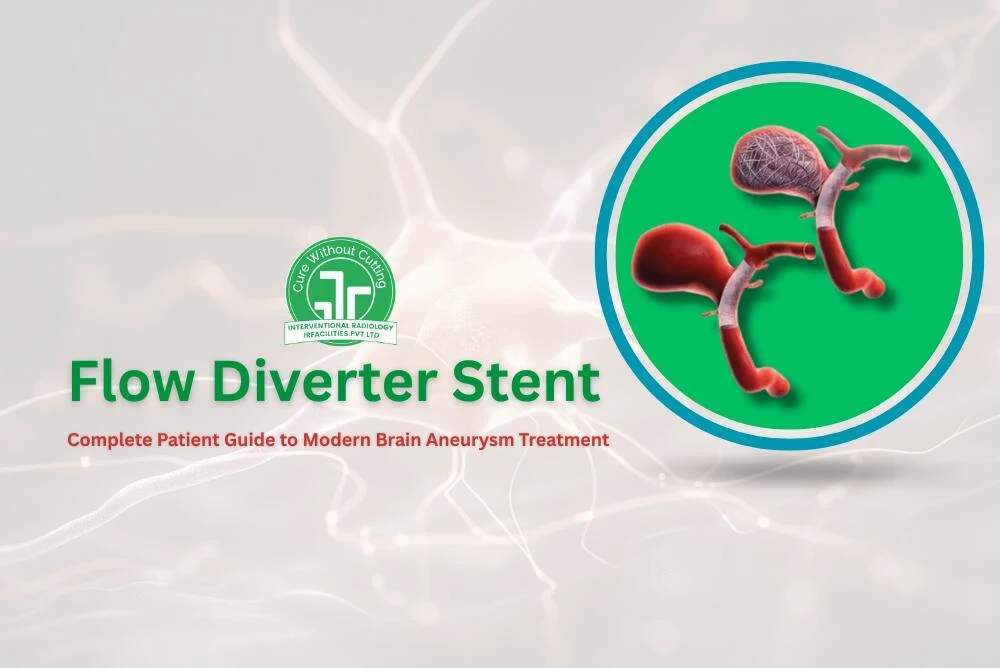
Flow Diverter Stent: Complete Patient Guide to Modern Brain Aneurysm Treatment
Most people carry one for years — no pain, no symptoms, no clue. Then one scan changes everything. The diagnosis lands hard. The fear is immediate. And the questions start coming faster than the answers.
But here is the one thing worth holding onto from the very start — treatments available today are genuinely life-changing compared to what existed even ten years ago.
The device leading that change? The flow diverter stent. For patients with large or complex aneurysms who were once told nothing could be done, this technology has completely rewritten what is possible.
First — Understanding the Problem
Every heartbeat pushes blood into that pocket. The wall stretches thinner over time. And the risk of rupture quietly grows.
When an aneurysm does rupture, blood floods the space around the brain. The survival odds are sobering — the mortality rate sits close to 40 percent. Survivors frequently face lasting neurological damage.
The treatment goal is simple to state, harder to achieve — eliminate the aneurysm before rupture happens. The real challenge has always been doing that safely, especially when the aneurysm is large, oddly shaped, or sitting somewhere difficult.
That is exactly where the flow diverter stent steps in.
So What Is a Flow Diverter Stent, Really?
Here is where most people expect complicated medical jargon. It is actually quite straightforward once you picture it correctly.
Traditional treatments went directly into the aneurysm. Surgeons either clipped it shut through open brain surgery — requiring a portion of the skull to be opened — or filled it with tiny platinum coils through a catheter to block blood flow inside it.
Both approaches work in the right situations. But both struggle badly when the aneurysm is large, wide-necked, or involves the entire vessel wall. Coils spill out of wide openings. Giant aneurysms need impossible coil volumes. Some aneurysm shapes simply cannot be coiled at all.
A flow diverter stent doesn't fight the aneurysm directly.
Instead, it sits inside the healthy artery running alongside the aneurysm. It is a small, dense mesh tube — deployed precisely across the aneurysm's opening like a screen door across a gap. Once in place, it quietly redirects blood along the artery's natural path, away from the aneurysm entirely.
Without blood continuously feeding it, the aneurysm begins clotting from within. New tissue gradually grows across its neck. Months later, it is sealed off completely — shrinking, silencing, eliminated.
No open skull surgery. No bone removed. No lengthy hospital stay. Just a catheter, skilled hands, and a device the size of a fingernail changing everything.
Who Is This Treatment Actually For?
Flow diversion is not a universal solution for every aneurysm. Smaller aneurysms with narrow necks often respond well to standard coiling. The real strength of this technology surfaces in the genuinely difficult cases — the ones that leave patients without good alternatives.
A flow diverter stent is typically recommended when:
- The aneurysm is large — over 10mm — or giant, exceeding 25mm
- The neck of the aneurysm is too wide for coils to sit without spilling
- The aneurysm wraps around the entire vessel wall rather than bulging from one side
- Previous coiling treatment has failed and the aneurysm has grown back
- The aneurysm sits along the internal carotid artery — common but anatomically tricky
If a doctor has described your aneurysm as complex, unsuitable for coiling, or difficult to treat — a flow diverter stent evaluation is exactly the next step worth taking.
The Procedure — Far Less Daunting Than Expected
Most patients walk into this conversation bracing for news about major brain surgery. What they actually hear is a very different story.
There is no incision in the skull. No craniotomy. No traditional open surgery of any kind.
Everything happens through a tiny puncture in the groin. A catheter enters the femoral artery and travels upward through the body's vascular system, guided by live X-ray imaging the entire way. A microcatheter then carries the tightly compressed stent to the exact location needed inside the brain's arterial network.
Once positioned correctly across the aneurysm neck, the stent self-expands — opening up and locking firmly against the vessel wall. Blood flow shifts immediately. The aneurysm begins its gradual closure.
The procedure takes one to three hours. Most patients spend a single night in hospital. Within one to two weeks, the majority are back to their normal routine — often surprised by how quickly they recovered.
The one commitment that cannot be skipped is medication. Patients take dual antiplatelet therapy — usually aspirin and clopidogrel — before and for several months after treatment. This prevents clotting on the stent surface while the body heals around it. Stopping this medication early, without medical guidance, is one of the most avoidable but serious risks to a good outcome.
What Results Look Like in Practice
The clinical data behind flow diverter stents is solid and genuinely reassuring.
Studies consistently show complete or near-complete aneurysm occlusion in 75 to 90 percent of patients within twelve months of treatment. For aneurysm types that previously had no reliable path forward, those numbers represent an enormous shift in prognosis.
Long-term durability is also significantly stronger than coiling alone — a fact that matters particularly for younger patients who need protection that holds for decades, not just years.
One thing every patient must understand going in: the results unfold gradually. The aneurysm does not disappear on the day of the procedure. Thrombosis and vessel wall remodeling are biological processes — they take time. Follow-up imaging at three, six, and twelve months tracks that progression and confirms everything is closing as it should.
Patience here is not passive waiting. It is part of how the treatment works.
The Risks — An Honest Breakdown
No procedure is without risk, and patients deserve to understand this clearly before making any decision.
Thromboembolic stroke is the primary concern — blood clots forming on the stent surface and traveling to other brain regions. This is the main reason antiplatelet medication is absolutely non-negotiable throughout the healing phase.
Delayed aneurysm rupture is uncommon but has been recorded during the weeks when the aneurysm is actively changing internally.
In-stent stenosis: narrowing of the artery at the stent site — affects a small number of patients and can restrict blood flow if undetected.
Perforator artery complications: can arise when the stent is deployed near small branching vessels feeding important brain regions.
Here is the context that matters most with all of these risks: in experienced hands, at dedicated high-volume centers, complication rates are consistently low. The expertise of the interventionalist is not a background detail — it is one of the most significant factors shaping every patient's outcome.
Recovery — A Realistic Month by Month Picture
Recovery is manageable for most patients, but it does require genuine commitment to the follow-up process.
Days 1 and 2: Hospital monitoring, neurological checks, and initial recovery. The groin puncture site heals quickly with very little discomfort.
Weeks 1 and 2: Home rest with antiplatelet medication continuing. Most patients feel physically well faster than they expected.
Month 3: First follow-up angiogram. The specialist checks early thrombosis progress and confirms stent positioning.
Months 6 to 12: Definitive imaging. This is typically when complete or near-complete occlusion is confirmed — the milestone most patients are waiting for.
Year 2 onward: Annual or biannual imaging to monitor long-term stability and catch any rare late changes early.
During recovery, contact your care team immediately if you notice a sudden severe headache, new weakness or numbness, difficulty speaking, or sudden vision changes. These symptoms are unlikely at this stage — but they should never be ignored or waited out.
Why the Right Center Makes All the Difference
This is the part of the conversation that does not get enough attention — and it genuinely should.
Placing a flow diverter stent inside a cerebral artery is technically demanding work. The tolerances are narrow. The anatomy is intricate. The judgment calls made during deployment — about sizing, positioning, and coverage — require experience built through consistent, high-volume practice over years.
A specialist who performs this procedure a handful of times per year and one who performs it weekly are not interchangeable. That difference shows up directly in outcomes.
When evaluating where to seek treatment, look for:
- A dedicated neurovascular program — not just a general neurosurgery department
- Biplane fluoroscopy imaging for real-time precision during the procedure
- A multidisciplinary team where neurologists, neurosurgeons, and interventional specialists work collaboratively
- High procedural volume specifically in flow diversion
- Transparent, unhurried communication about risks, timelines, and expectations
At IRFacilities, every one of these standards defines how the neurovascular program operates. Dr. Sandeep Sharma brings both deep technical expertise and a genuinely patient-first approach to this work — treating each case as the individual puzzle it is, rather than applying a standard protocol without thought.
A Word for Patients Who Were Told "Nothing Can Be Done"
Before flow diversion existed, many patients with giant, fusiform, or anatomically complex aneurysms left specialist consultations with no real treatment option. They were monitored. They were counseled on lifestyle. And they carried quiet anxiety that never fully lifted.
That reality has changed — significantly.
If you received a discouraging assessment several years ago, a fresh evaluation at a dedicated flow diversion center is absolutely worth pursuing. The technology has advanced. Specialist experience has deepened. What was genuinely impossible then may be very achievable now.
Closing Thoughts
A brain aneurysm diagnosis is one of the harder things a person can face. The fear is real. The uncertainty is real.
But so is the progress that modern neurovascular medicine has made — and the flow diverter stent stands as one of the most meaningful examples of that progress. It has created real pathways for patients with complex, large, or previously untreatable aneurysms. Without open surgery. Without prolonged recovery. With results that hold up over time.
If you are navigating this diagnosis right now, pursue a thorough specialist evaluation. Ask directly about flow diversion. Ask whether your anatomy qualifies. Ask what outcomes look like for your specific case.
The right team, with the right tools, can genuinely change what is possible for you.
Ready to Discuss?
Share your symptoms and reports with our team. We help you understand whether you need treatment now or simple lifestyle changes and follow‑up.