Stroke: What to Do in the First Few Hours (Mohali & Gurugram Guide)
It usually happens at the most ordinary moment. Papa is reading the newspaper, and suddenly the cup slips from his hand. Mummy is talking on the phone, and her words start coming out wrong. Someone notices one side of the face looks different.
What the family does in the next hour can decide how much of that person comes back.
This isn't meant to scare you. It's meant to be the one page you remember when it matters.
Spot it: BE FAST
Keep this simple check in mind:
- B – Balance: sudden dizziness, can't walk straight
- E – Eyes: sudden blurred or lost vision in one or both eyes
- F – Face: ask them to smile. Does one side droop?
- A – Arms: ask them to raise both arms. Does one drift down?
- S – Speech: slurred, strange, or they can't understand you
- T – Time: note the time it started and get help immediately
A sudden, severe headache, often described as "the worst headache of my life", can mean bleeding in the brain. That's an emergency too.
What to do, step by step
- Note the time. Doctors will ask, "When was the patient last seen normal?" This one answer shapes the whole treatment plan.
- Call for help. Dial 112 or 108 for an ambulance, or drive to the nearest hospital with a CT scan and stroke team if that's faster.
- Don't give anything by mouth. No water, no tablets, no desi ghee, no home remedies. Swallowing may be affected, and some strokes are bleeds, where the wrong medicine can make things worse.
- Don't wait for it to settle. Even if symptoms improve, it could be a mini-stroke (TIA), a warning that a bigger one may follow.
- Carry the medicine list and any old reports if you can grab them in a few seconds. Don't waste time searching.
Why time matters so much
In the most common type of stroke, a clot blocks an artery in the brain. Every minute that blood can't get through, brain cells are lost.
There are two main ways to open the blocked artery:
- Clot-dissolving medicine given through a drip, which works best in the first few hours after symptoms start.
- Mechanical thrombectomy, where a neuro-interventional specialist goes in through a small puncture in the groin or wrist, reaches the clot in the brain, and physically pulls it out. For selected patients with a large blocked artery, this can help even several hours after onset, depending on what the scans show.
Thrombectomy is a highly specialised procedure. It needs a trained neuro-interventional radiologist, a cath lab and a team ready to move fast. Not every hospital has all three, day and night.
If it's a bleed, not a clot
Some strokes are caused by bleeding, often from a weak spot in a blood vessel (an aneurysm) or an abnormal tangle of vessels (an AVM). Here too, treatment from inside the vessels, such as coiling or flow diverters, can seal the problem without opening the skull in many cases.
Stroke care in Mohali and Gurugram
IR Facilities is led by Dr. Sandeep Sharma, MD, DM (Interventional Neuroradiology), a super-specialist in treating the brain through its blood vessels. Our teams handle stroke and brain bleed emergencies, including on Sundays.
- Mohali: 3rd floor, Shivalik Hospital, Sector 69, SAS Nagar, for Mohali, Chandigarh, Panchkula, Zirakpur and Kharar
- Gurugram: near Manipal Hospital, Sector 23A, for Gurugram, Manesar, Dwarka and South Delhi
Save this number in your phone today: +91-86999 77915. Share it on your family WhatsApp group too. The day you need it, you won't want to be searching for it.
After the emergency
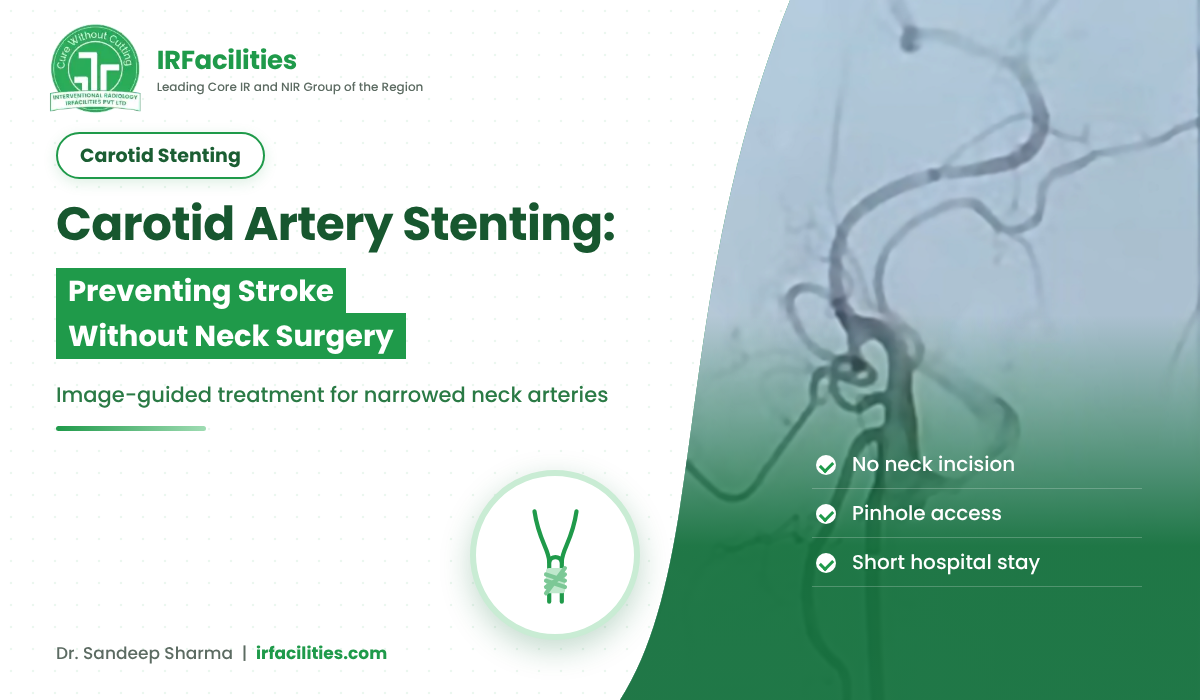
Surviving a stroke is the first step. Preventing the next one matters just as much: controlling blood pressure, sugar and cholesterol, quitting smoking, and sometimes treating a narrowed neck artery with carotid stenting. We'll guide you on this at follow-up.
Ready to Discuss?
Share your symptoms and reports with our team. We help you understand whether you need treatment now or simple lifestyle changes and follow‑up.