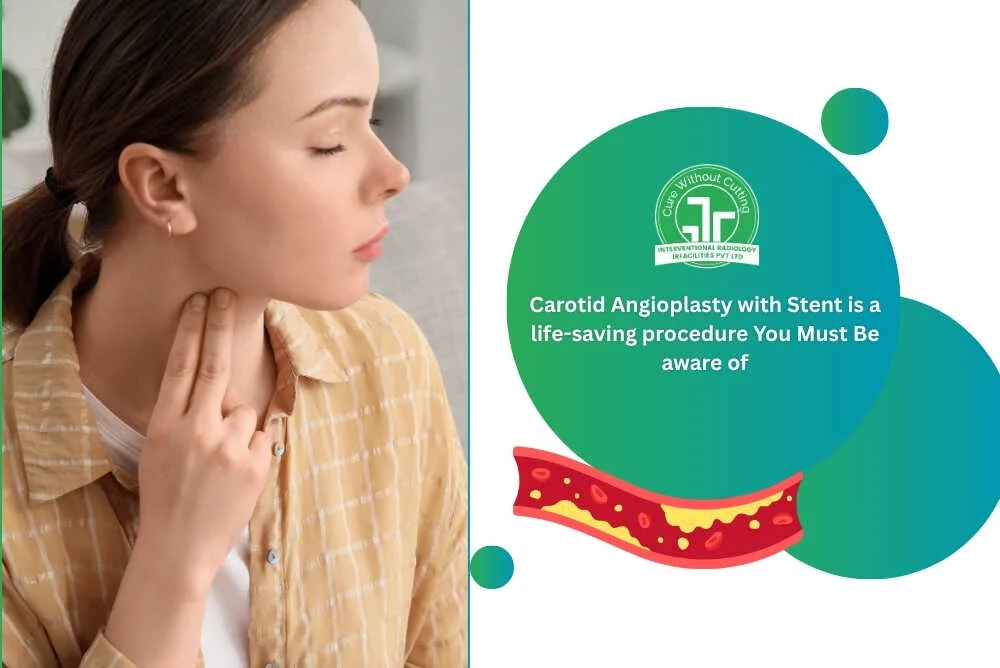
Carotid Angioplasty with Stent is a life-saving procedure You Must Be aware of
The protection of your brain from Stroke - One Stent at a time
Every year thousands of patients suffer from strokes due to blocked arteries in the neck. It's a frightening experience. It's often unexpected. It is also common that it's entirely avoidable.
The positive side? Carotid Angioplasty with Stent is a cutting-edge minimally-invasive procedure that significantly lowers the risk of stroke without the necessity of open surgery. Patients are increasingly choosing this procedure. Doctors are more inclined to recommend it. The outcomes speak for themselves.
Let's break it into simple, easy words.
What exactly is Carotid Angioplasty with Stent?
Your carotid veins are two blood vessels of immense size located on either the neck's side. Their function is straightforward but crucial: transport high-oxygen blood to the brain from your heart.
Imagine the blood vessels becoming clogged by plaques of fatty material. The passageway narrows. The blood flow slows. The brain is losing oxygen. At any time the piece of plaque may break and move to the brain and lead to stroke.
This is the point at which carotid angioplasty using stent comes into.
In this method an expert guides an inflatable balloon through the blocked blood vessel. The balloon is then inflated to expand the artery. A small mesh tube, also known as the stent is put inside the artery to keep it open for the duration of time.
No large cuts. No stitches around the neck. A general anesthesia is not required in most instances. It's a simple puncture, a competent hands and transformative outcomes.
Who Should Consider This Procedure?
You could be a good potential candidate carotid angioplasty using stent in the event that you fall into one of the following categories:
- Your arterial artery is blocked by 50 to 99% because plaque buildup
- You've had an accident and you want to avoid the possibility of having another
- You were struck by an TIA -A temporary "mini stroke" which served as warning signal
- You suffer from an underlying heart problem, diabetic or other medical conditions which make traditional surgical procedures too risky.
- You're older and would like a less risky and less trauma-inducing alternative to open surgery.
If these sounds familiar, don't overlook the signs. Early intervention could be the key to determining whether you will recover fully or suffer permanent disability.
How Does the Procedure Actually Work?
This is a step-by-step guide at the procedure of Carotid Angioplasty with Stent that is explained in simple terms:
Step 1 -- Access Point
A tiny puncture is made within the groin area. This is the place where the catheter is introduced into the body.
Step 2 -- Navigation
Utilizing live X-ray images The doctor will carefully guide the catheter through the blood vessels of your body towards the carotid artery.
Step 3 -- Protection First
A small filter protects located just above the obstruction. It captures any loose plaque particles that might fall off in the course of treatment.
Step 4 -- Opening the Artery
A balloon of a small size is inflated at the point of narrowing. The balloon gentle pushes the plaque away and broadens the arterial.
Step 5 -- Placing the Stent
A self-expanding, self-expanding stent can be deployed to keep the artery open. It then becomes a permanent supporting scaffold within the vessel.
What Happens After the Procedure?
It is easy to recover for the majority of patients.
The doctor will prescribe blood-thinning medication -- usually Clopidogrel and aspirin -- for a number of months. They prevent blood clots around the new stent.
Regular follow-up care is provided by regular Doppler ultrasounds to check the flow of blood and stent function. Your doctor will guide through each step of the checkpoint.
Lifestyle modifications also contribute to the long-term health. Smoking less and eating healthy foods as well as controlling blood pressure, keeping physically active -- all of these behaviors help protect your stent as well as overall health of your vascular system.
A lot of patients say they feel great after a few weeks of the procedure. They feel more alert. More active. More like them. This is how your brain works when it finally receives enough blood supply it requires.
Choose the Right Specialist -- It Matters More Than You Think
It is an extremely delicate, extremely precise process. The final outcome is dependent upon the knowledge and expertise of the expert who performs the procedure.
At IRFacilities Patients benefit from high-tech interventional equipment and expert medical care from Dr. Sandeep Sharma -- a highly regarded vascular and interventional doctor who has a proven experience in complex carotid surgeries. His philosophy of patient-first, paired with cutting-edge imaging and a minimally invasive method makes sure that every patient receives effective, safe and compassionate care from beginning to end.
In terms of improving your mental health are entitled to only the absolute best.
Final Thoughts -- Act Before It Is Too Late
Stroke doesn't always provide an indication. However, when it doesby displaying symptoms such as sudden blurred vision, dizziness the appearance of drooping eyes, or arm weakness -- the warning should be considered seriously.
Carotid Angioplasty with Stent is more than an operation for medical reasons. It's an opportunity to relive hope. It's hope restored. It's the possibility to take your child across the aisle or travel with your spouse or simply get up the next day without worry.
Don't wait for strokes to stop you from having you to have a conversation. Contact a specialist now and take the first step towards protecting you and your mind, as well as your freedom as well as your foreseeable future.
Ready to Discuss?
Share your symptoms and reports with our team. We help you understand whether you need treatment now or simple lifestyle changes and follow‑up.